image: "/blog/why-tokenism-isnt-enough-muslim-girls-deserve-real-toys-hero.webp" title: "Why Tokenism Isn't Enough — Muslim Girls Deserve Real Toys, Not Checkmarks" description: "When a viral video asks what positive Muslim representation actually means, it hits different if you've ever watched your kid flip through a sticker book and find nobody who looks like her." date: "2026-06-03" slug: "why-tokenism-isnt-enough-muslim-girls-deserve-real-toys" category: "Representation" tags:
- Muslim girls representation
- tokenism in children's media
- hijabi sticker books
- islamic toys
- muslim parenting
There's a video going around right now from a creator named Yazmeen Kanji. It's two minutes long. In it, she says something that stopped me mid-scroll: "Everyone keeps asking for positive Muslim representation, but I think we're asking the wrong question."
Not "we need more representation." Not "we're making progress." She pushed past all of that and went straight to the thing most people don't want to say out loud. What does positive representation actually mean when it's done badly? When a studio adds a hijabi character to the background of a scene for two seconds and calls it a day? When a toy company slaps a headscarf on an existing doll and moves on?
That video landed the same week a girl in Dearborn got hate comments for wearing hijab to a memorial — and then called out what she called "the fetishizing of hijab and hijabi tokenism in the media." Two different women, same week, same point: being seen isn't the same as being understood.
Tokenism looks like a hijab on a doll that doesn't make sense
I'll tell you what tokenism looks like from the parent side. Last December, Blair and I were shopping for gifts for her friends at the masjid. Sticker books seemed easy enough. She flipped through the first one, then the second, then the third. Every single book had the same setup: girls in crop tops, short skirts, sleeveless dresses. Plenty of diversity in skin tone, plenty of different hairstyles. Not a single hijab anywhere.
We went home. Catherine helped us search Etsy, Amazon, specialty shops online. Nothing. Not nothing expensive. Not nothing obscure. Just nothing.
A few days later Catherine said what Blair was already thinking: "Let's just make them ourselves."
We didn't set out to make a statement about representation. We set out to make a sticker book Blair's friends would actually want to play with. But the reason that book didn't exist wasn't because nobody wanted it. It's because the companies making sticker books never stopped to ask whether their products were leaving anybody out.
That's what tokenism does. It doesn't exclude you on purpose. It just never thinks about you at all. Then, if pressed, it adds you in the cheapest, most surface-level way possible and expects gratitude.
The difference between showing up and showing up right
Almost half of American Muslim children experience bullying or discrimination in school. That's from Noor Kids' research, not my hunch. When anti-Muslim rhetoric rises — and it's rising right now — representation stops being a nice-to-have and starts being a shield.
But the quality of that representation matters more than the quantity.
A hijabi character who only appears in a storyline about being Muslim? That's not representation, that's being used as a plot device. A sticker book with one token hijabi girl wedged into the corner of a page full of characters doing fun things? That's not inclusion, that's compliance.
Real representation looks like a girl in a hijab doing normal stuff. Playing at the park. Putting together outfits that she actually might wear. Picking a face sticker that has her features. It doesn't center her hijab as the entire story. It centers her as a kid who happens to wear one.
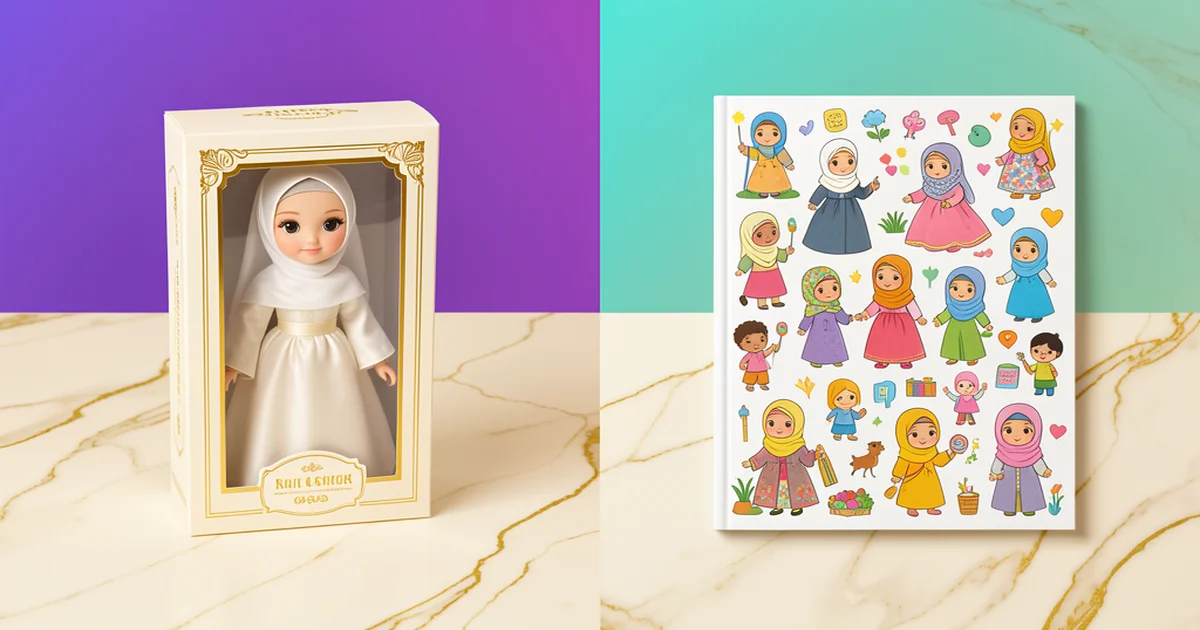
That's what we tried to build. Little Hijabi Adventures has 50-plus stickers for ages three and up, and none of them treat the hijab as a novelty. It's just there, the way it is for the kids who'll use the book. Beautiful Hijabi lets girls create their own hijabi characters — face stickers, outfit stickers, the whole thing. Modest Hijabi Fashion is for the eight-and-up crowd who want to put together actual outfits they'd want to wear.
The Beautiful Hijabi app does the same thing on a screen: 100-plus stickers, no ads, no subscriptions, just a creative space that costs $2.99 once. Blair and Catherine built it because the sticker books only go so far, and a phone screen is where kids already spend their time. Might as well make that space work for them.
The question we should actually be asking
Yazmeen Kanji's video got me thinking. Not about whether representation matters — it does, and the data backs that up. But about what version of representation we're settling for.
Right now, the Islamic toy market is growing. Omar and Hana singing dolls are trending. Mosque dollhouses are a thing on TikTok. Screen-free Islamic gramophones are going viral. Parents are spending real money on products that reflect their kids' lives.
That's good. But it's also a moment where we get to decide: are we building the same tokenism problem inside our own community, just with halal branding? Or are we building something that actually lets Muslim girls see themselves as whole people?
I think the answer is in the details. It's in a sticker book where the hijabi girl isn't on page seven as an afterthought. It's in an app where creating a modest outfit isn't the "special mode" — it's the starting point.
Blair didn't ask for a movement when she couldn't find a sticker book for her friends. She asked for something to give them. But sometimes the simplest request is the one that reveals the biggest gap.
If your daughter has ever looked at a toy or a book or a screen and said, "None of these girls look like me," you already know the gap is real. The question is what we do about it — and whether we do it properly this time.